Home › Articles › Anxiety at night: why it gets worse when you lie down
Anxiety at night: why it gets worse when you lie down
By Alessio, Certified Breathwork Instructor · last reviewed 2026-10-19
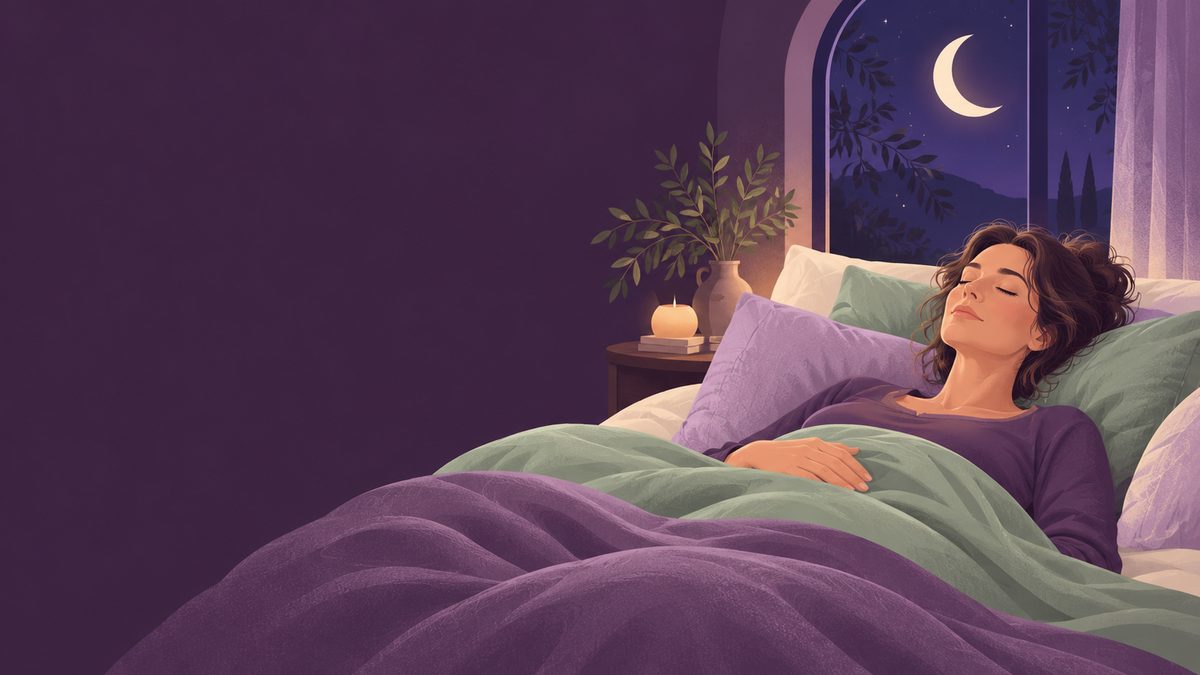
All day you were fine. Busy, but fine. Then you turn the light off, and your mind turns on.
Anxiety at night is very common, and it really does get worse in bed. That's not your imagination. There are simple reasons for it, and there is something small you can do about it tonight.
Key takeaways
- At night the noise of the day stops, and your worries are the only thing left. Your body may still be in day mode, too.
- Trying hard to fall asleep keeps you awake. The fear of not sleeping becomes the new worry.
- A slow breath with a long exhale is the simplest signal you can give your body that the day is over. Two minutes is a gentle place to start.
Why anxiety gets worse at night
Think of your day as a busy café. Music, voices, cups, people. Your worries are there all day, but you can't hear them over the noise.
At night the café closes. The music stops, the people go home. Now there is only one voice left in the room, and it's the one saying: what if?
That's the first reason. Nothing is distracting you anymore. No emails, no tasks, no one to talk to. Everyone else is asleep, and that can make the worry feel even louder.
The second reason is in the body, not the mind. If your day was full-on, your body doesn't switch off just because you lie down. Your heart is still a bit fast. Your breath is still short and high in the chest, the way we breathe under stress. You feel tired, but wired. Your mind looks around for a reason, and it always finds one.
The third reason is the loop. You start worrying about not sleeping, and about tomorrow, and the worry itself keeps you awake. That loop has its own page: sleep anxiety.
Why it feels worse when you lie down
Lying still in the dark, you start to notice things you didn't feel all day: your heartbeat, your breath, a tight chest or jaw. They were there during the day too, under the noise. Now they're the only thing your mind can watch, and watching them makes them feel bigger.
Often that's tension. But if a symptom is new, strong, or just feels wrong, don't put it down to anxiety. Read the doctor section below.
What I learned the hard way
For years, I lived with anxiety and a mind that was always on. From the outside I looked fine. Inside, never off.
In 2020, I found breathwork, and I did what people like us do. I went for the strongest techniques, fast and hard. The first time, I nearly passed out in my garden.
That day taught me the thing I still teach first: your body has its own timing. You can't force calm, and you can't force sleep. You can only slow down and let it come.
So at night, don't fight your mind. You won't win that one. Talk to your body instead. The breath is the one part of the stress response you can change on purpose.
Try this now: the long exhale in bed
This is the gentlest breath I know. No holds, and nobody next to you will notice. In a review of small studies, slow breathing was linked to feeling more relaxed, though the evidence is still limited (Zaccaro et al., 2018). The numbers are only a guide: what matters is that the breath out is longer than the breath in.
- Lie on your back or on your side, whatever is comfortable. Put one hand on your belly.
- Breathe in slowly through your nose for about 4. Let the belly rise under your hand. Not a big breath, about two-thirds full.
- Breathe out slowly through your nose for about 8. Smooth and even.
- Let a small natural pause happen at the end. Don't force it.
- Keep going for 2 minutes. If 8 feels too long, use 6, or even 5. Never strain for air. The point is simple: longer out than in.
If even 4 feels like too much, start smaller. Doctors Patricia Gerbarg and Richard Brown let anxious patients who found slow breathing hard begin at 3 seconds in and 3 or more out.
How long: 2 minutes is a gentle place to start. Some people feel a shift quickly, others need a few nights. On a bad night, keep going for 5 to 10. How often: every night when you turn the light off, and again if you wake up and your mind starts.
Do it now with the 2-minute timer. Breathe with the circle, then put the phone face down.
If your mind keeps talking: count the exhales, from 1 to 10, then start again. Counting gives your attention something simple to come back to when the worries pull it away. If you lose count, no problem. Start again from 1.
If your heart is pounding: anxiety can do that, and you may notice it slows a little on every breath out. Keep the exhale long and let it settle at its own pace. But don't assume anxiety is always the cause. If it's new, very fast, or comes with chest pain or dizziness, see the doctor section below.
If the feeling is big: lie on your back, bend your knees and hug them gently to your chest. Feel your belly rise toward your thighs as you breathe in, and sink as you breathe out. This shape helps with big feelings: being held, even by your own arms, can make them feel less overwhelming.
If you wake up in the middle of the night
Try not to look at the clock, and do the long exhale for a few minutes. If you're still wide awake after that, waking up at 3am every night has what to do next.
Small things during the day that make nights easier
- Keep caffeine at least 6 hours away from bedtime, longer if you're sensitive. It can keep your body alert long after you stop feeling it. More on that in caffeine, anxiety and sleep.
- Go easy on alcohol in the evening. It can help you fall asleep, but it breaks up your sleep in the second half of the night (Thakkar et al., 2015).
- Put the screens away at least an hour before bed. Some people prefer 90 minutes.
- Keep the bedroom cool, and have your last meal at least two hours before bed.
- Get some daylight soon after you wake up. It helps your body know when it's day, and later, when it's night. More in morning anxiety.
When to see a doctor
Breathing is a relaxation practice, not medical care. It works alongside whatever else you're doing, including therapy or medication. Don't change either because of this article.
Get urgent help now if you have new or severe chest pain, serious trouble breathing, you faint, or your heart races with chest pain or dizziness. Call your local emergency number. Don't assume anxiety is the cause.
Book an appointment with your doctor if:
- anxiety keeps you awake most nights for more than a few weeks. Cognitive behavioral therapy (CBT) is one of the treatments for insomnia (NHS). Your doctor can tell you what's available.
- you often wake up with panic: a racing heart, trouble breathing, a feeling of doom.
- your heartbeat feels wrong, even when you're calm.
- someone tells you that you snore loudly or stop breathing in your sleep.
- your mood is low most days, or you need alcohol or pills to sleep.
If focusing on your breath makes you feel worse, stop. Open your eyes and just make the breath out a little longer. That's enough.
FAQ
Why is my anxiety worse at night?
For many people, bedtime is the first quiet moment of the whole day. It's the first time the mind has space to bring everything up. That's very common, and it doesn't mean something is wrong with you. If it happens most nights for weeks, read the doctor section above.
Why does anxiety feel worse when I lie down?
In the quiet, you notice your heartbeat, breath and tension more, and your mind starts watching them. If a symptom is new or strong, get it checked.
How can I calm anxiety at night fast?
Breathe out for longer than you breathe in: in for about 4, out for 6 to 8, for 2 minutes. If counting helps, count the exhales. Keep the phone away, except for the timer.
Keep going
- Long exhale breathing: the full technique.
- Belly breathing with a pillow: if your breath sits high in your chest.
- 4-7-8 breathing: a counted breath for falling asleep. It has a breath hold, so read the safety notes on that page first.
- Free 10-minute practice for the moment you turn the light off.
Sources: M. Pistono, Breathe How You Want to Feel (sleep habits, screens, counting, extended exhales) · J. Nestor, Breath, 2020 (Gerbarg and Brown, starting at 3 seconds) · J. Hall, Breathe (Self-soothing Breath) · Zaccaro et al., Front Hum Neurosci 2018 · Thakkar et al., Alcohol 2015 · NHS: Insomnia · Alessio's own experience.
Can't switch off at night?
Get my free 10-minute guided practice for the moment you turn the light off. Gentle: no breath holds, no fast breathing.