Home › Articles › How to stop overthinking at night
How to stop overthinking at night
By Alessio, Certified Breathwork Instructor · last reviewed 2026-10-21
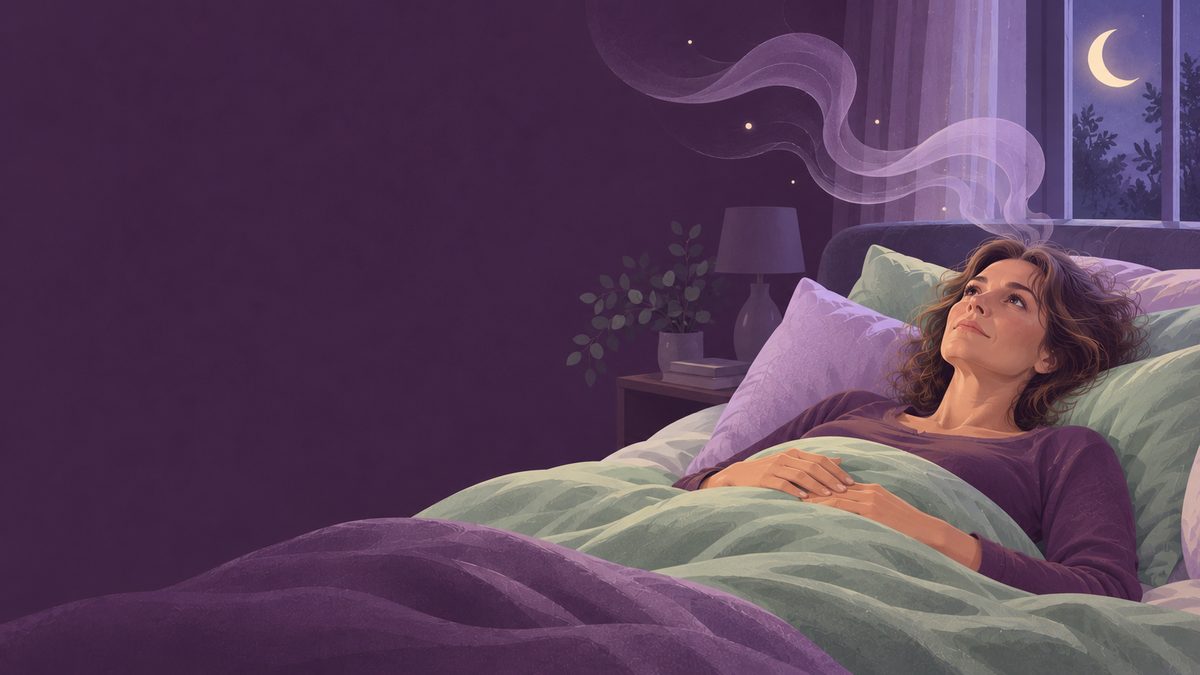
You lie down, close your eyes, and the replay starts. What you said in that meeting. The email you sent too fast. The look on someone's face. Overthinking at night has a special talent: it only shows the bad moments. The way out is to give your attention somewhere else to go: your breath and your body.
Below is exactly how to do that in bed, tonight.
Key takeaways
- You can't think your way out of overthinking. Arguing with the thoughts keeps you in them.
- Your attention can't follow everything at once. Give it the breath and the body, and the replay starts to lose its audience.
- A slow breath plus a simple body scan, in bed, 7 to 12 minutes in total, is enough to start.
Why your brain replays the day at night
Your mind at night is like a sports channel that only shows the missed goals. Over and over, from every angle, in slow motion.
At 11pm there is nothing left to fix. There's only the replay, and a body that gets more wound up every time it watches.
And it's a loop. A thought comes, your body reacts with a little stress, and the stress feeds the next thought. Thought, reaction, thought, reaction.
If the day's quiet makes all of this louder, I wrote about that in why anxiety gets worse at night.
What helped me
Back then, in my mind I was replaying my mistakes of the day, and feeling guilty about them.
Breathing deeply, and starting to focus more on my breath and my body, helped me so much.
Here's the idea behind it: you're not your thoughts. You can watch them go past. You don't have to follow every one of them into the next room.
Meditating doesn't have to mean sitting with your eyes closed, trying not to think. It means being fully present to what is there. In bed, what is there is your breath and your body.
Try this now: breath and body scan in bed
Do this lying down, lights off, in the position you sleep in. Lying down helps: in a relaxed position, it's easier for the breath to slow down and soften.
Part 1: slow the breath (2 minutes)
Hand on your belly, and let each breath out be longer than the breath in. Nothing more to it. If you want the steps, they're in the long exhale in bed, or you can follow the 2-minute timer. Then go straight on to part 2. If watching your breath winds you up, open your eyes and skip the counting.
Part 2: walk through the body (5 to 10 minutes)
Now let the breath go back to normal and move your attention slowly through the body. At each place, just notice what is really there: the pillow, the sheet, warmth, tension. Nothing to change. Just notice.
- Eyebrows and forehead.
- Face, jaw, and the tongue resting in your mouth.
- Throat.
- Right shoulder, arm, hand. Then the left.
- Chest, then belly. Feel them move with the breath.
- Hips.
- Right leg and foot. Then the left.
- Back, from the bottom up, slowly.
- Back of the head, then the top of the head.
When a thought pulls you away (and it will, maybe 50 times): notice it. Don't follow it, don't fight it. Go back to the last part of the body you remember. Coming back is the practice, not a failure.
If you fall asleep before you reach the top of your head, good. If you don't, that's fine too. You've still given your body 10 quiet minutes instead of 10 minutes of replay.
If the thoughts are very loud
Some nights the body scan is too quiet for the mind. Then give the brain something more to hold on to, like counting the breaths out (details in anxiety at night). It's hard to count and worry at the same time.
During the day
What you do in the evening matters too. A brain that is still buzzing at 11pm finds more things to replay. The habits that help most (coffee, alcohol, screens, morning light) are in anxiety at night.
When to see a doctor
Overthinking now and then is part of being human. Please talk to your doctor or a therapist if:
- you overthink most nights and it's been going on for weeks.
- the guilt doesn't go away, or your mood is low most days.
- you can't stop checking or repeating things to feel safe.
- you're sleeping so little that your days are falling apart.
If you ever have thoughts of hurting yourself, please don't wait. Contact your local emergency number or a crisis line now. In the US, call or text 988 (988lifeline.org).
Breathing is a relaxation practice, not medical care. It works alongside whatever else you're doing.
FAQ
Why do I overthink at night?
Because a brain that couldn't finish its work during the day tries to finish it in bed. It goes for what felt unresolved: the awkward comment, the email you didn't send. It's very common, and it isn't a sign that something is wrong with you.
How do I stop overthinking at night and fall asleep?
Stop trying to win the argument with your thoughts. Slow your breath for 2 minutes, then move your attention slowly through your body, from the head to the feet. When a thought pulls you away, come back to the body. That's the whole method.
Why do I keep replaying conversations in my head?
It's very common, especially with moments that felt awkward or unfinished. At night it only keeps your body tense. Notice the replay, name it ("replaying again"), and bring your attention back to your breath.
Keep going
- Anxiety at night: why it gets worse when you lie down.
- Long exhale breathing: the full technique.
- Belly breathing with a pillow: if your breath sits high in your chest.
- Free 10-minute practice for the moment you turn the light off.
Sources: J. Hall, Breathe (Simple Breath Awareness, lying down) · F. Lenoir, Rallenta, ascolta, respira (presence, not emptying the mind) · M. Pistono, Breathe How You Want to Feel (thought-reaction loop, counting and worry, sleep habits) · Yogalap instructor course (longer exhale for calm) · Alessio's own experience.
Can't switch off at night?
Get my free 10-minute guided practice for the moment you turn the light off. Gentle: no breath holds, no fast breathing.