Home › Articles › Racing thoughts at night: when your brain won't switch off
Racing thoughts at night: when your brain won't switch off
By Alessio, Certified Breathwork Instructor · last reviewed 2026-10-28
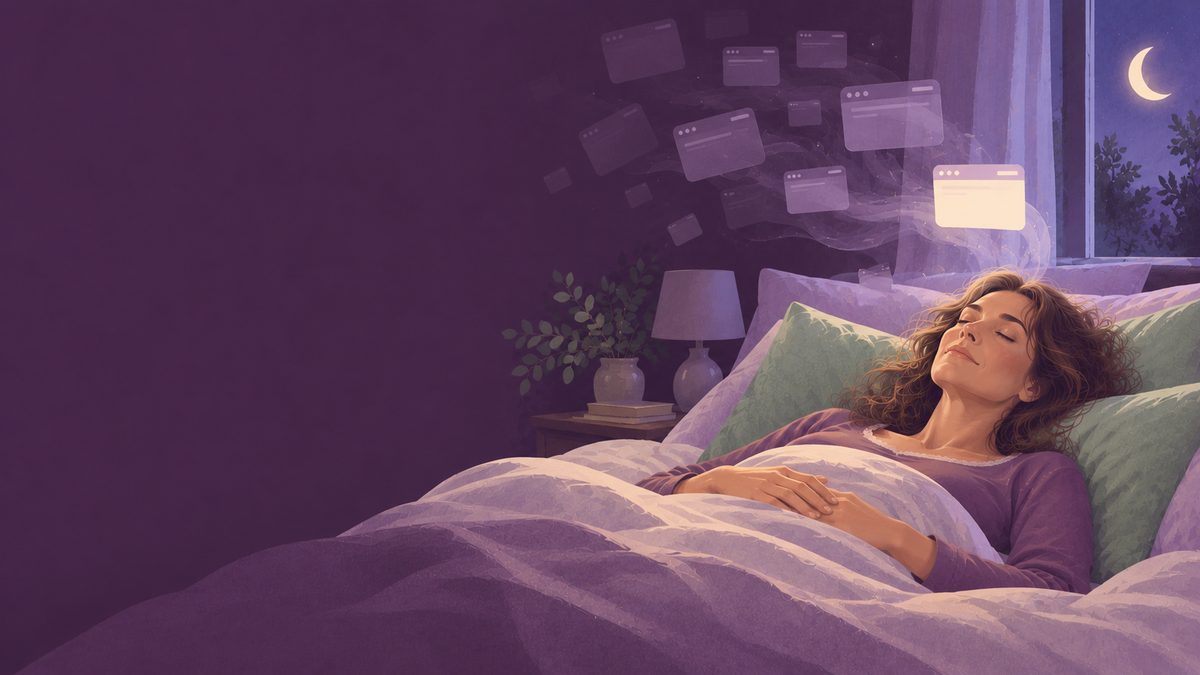
Some people lie down and slowly fade. Others lie down and the brain says: great, now we finally have time. Ideas, plans, songs, a conversation from last week, something you forgot to buy. Not always worries. Just more.
If you have ADHD, or you simply have one of those brains that never seems to switch off, racing thoughts at night can keep you up until the early hours. This page is for you. The short answer: give your busy brain one slow job to do, like the breath below. No "just relax", I promise.
Key takeaways
- A busy brain doesn't switch off because the light goes off. It needs a bridge from doing to resting.
- Telling an always-on brain to "empty itself" rarely works. Giving it a simple job can work better.
- Alternate nostril breathing gives your hands, your attention and your breath one small task, which can be just what a racing mind needs.
Why your brain speeds up at bedtime
Picture your mind as a web browser with forty tabs open. All day, you click between them. At night you close the laptop, but the tabs are still there, still loading, some of them playing music.
When the day's noise stops, a busy brain notices every open tab at once. Some people with ADHD find this moment especially hard: the brain is tired, but it's also finally free, and it doesn't want to stop.
On top of that, many always-on people push their bedtime later and later, because the evening is the only quiet time they get. A review of the research on adults with ADHD describes many of them as "evening" or "night" people, with a body clock that runs late (Kooij and Bijlenga, 2013). The later it gets, the more wired and tired you become at the same time.
How I used to switch off
My evenings were simple: I needed something to knock me out, just to stop thinking. Otherwise I couldn't go to sleep until very late, almost morning.
It wasn't good for me, of course. I had to numb myself to stop thinking.
But numbing a busy brain isn't the only way to quiet it. You can also give it something slow to do.
Try this now: alternate nostril breathing, gently
This is a very old yoga breath. It's traditionally used to prepare for meditation, for clarity, focus and relaxation. That means awake enough to pay attention, quiet enough to settle. For a racing mind, the useful part is simple: your fingers, your attention and your breath all have one small job.
We'll do it without breath holds, which suits an anxious or busy night better. Keep the breath natural and comfortable, with no need to make it deep. It's a way to focus and relax. It doesn't change ADHD itself.
- Sit up in bed against the headboard, or sit on the edge of the bed. Relax your face.
- Bring your right hand to your nose. You'll use your thumb for the right nostril and your ring finger for the left. Fold your index and middle fingers into your palm, or rest them between your eyebrows.
- Close the right nostril with your thumb. Breathe in slowly through the left for about 4.
- Close the left nostril with your ring finger, open the right. Breathe out slowly through the right for about 4 or 5.
- Breathe in through the right for about 4.
- Close the right, open the left. Breathe out through the left.
- That's one round. Keep going for around 5 minutes, which is about 10 rounds. Don't worry about the exact number. If you lose track of which side you're on, smile, and start again from the left.
How long: about 5 minutes. Stop if: you feel dizzy, light-headed or tense. Rest and breathe normally. How often: every night before you lie down. Then lie down and let the breath go back to normal.
Keep the touch light. Your fingers just rest on the nose. If one side is blocked, breathe through the other side only. If your nose is fully blocked, or you've had recent nose surgery or have a nose infection, skip this one and use the long exhale instead.
Then: one tab at a time
When you lie down after the breath, some tabs will open again. That's fine. Don't try to close them all.
Pick one thing to feel: the breath going out through your nose, or the weight of your body on the mattress. One tab at a time.
If your brain wants more to do, add a count to the breaths out (see anxiety at night). If focusing on the breath tightens you up instead, look around the room and simply let each breath out be a bit longer than the breath in (long exhale breathing).
A few things that help an always-on brain
- Give the evening an ending. The same small routine every night: dim lights, breath, bed. A clear signal helps.
- Get the tabs out of your head. If ideas keep coming, keep a notebook by the bed and write a few words. Then the brain doesn't have to hold them.
- Watch what you use to come down. A drink or an hour of scrolling can feel like it helps. Why it backfires is in anxiety at night.
When to see a doctor
Please talk to your doctor if:
- racing thoughts keep you awake most nights for weeks.
- you think you might have ADHD and have never been assessed. Good support exists for adults.
- you rely on alcohol, cannabis or sleeping pills to switch off.
- you go through periods of needing very little sleep and feeling unusually high, irritable or full of energy, especially with impulsive or risky choices. Get this checked soon.
- your mood is low most days.
Breathing is a relaxation practice, not medical care. It works alongside whatever else you're doing, including any ADHD treatment.
FAQ
Why do I get racing thoughts at night?
Because a busy brain doesn't have an off switch, only a slower gear, and lying still doesn't find it by itself. So it keeps opening new tabs. Many people with ADHD, or under a lot of stress, describe exactly this.
How do I calm racing thoughts with ADHD at night?
Don't ask your brain to go blank. Give it a slow, simple job instead: alternate nostril breathing, counting breaths out, or feeling one part of your body at a time. A fixed evening routine helps too.
Is alternate nostril breathing safe?
For most people, yes, especially the gentle version without breath holds. Skip it if your nose is blocked, or if you've had recent nose surgery or a nose infection. Stop if you feel dizzy or uncomfortable.
Keep going
- How to stop overthinking at night: when it's worry, not just noise.
- Anxiety at night: why it gets worse when you lie down.
- Free 10-minute practice for the moment you turn the light off.
Sources: M. Pistono, Breathe How You Want to Feel (Alternate Nostril Breathing, to prepare for meditation: clarity, focus, relaxation) · J. Hall, Breathe (Inner Cleansing Breath: finger positions only; her version adds a breath hold that we leave out) · Kooij and Bijlenga, Expert Rev Neurother 2013 (ADHD and a late body clock) · Alessio's own experience.
Can't switch off at night?
Get my free 10-minute guided practice for the moment you turn the light off. Gentle: no breath holds, no fast breathing.
Keep reading
 Perimenopause anxiety at nightPerimenopause anxiety at night can feel like it came from nowhere. Learn why sleep and mood change, and try a gentle side-lying breathing practice.Read →
 Waking up with a panic attackWaking up with a panic attack, racing heart or shaking? What may be happening, and a gentle breathing and self-holding practice for the first minute.Read →
 Waking up at 3am every nightWaking up at 3am with your mind racing? What may be behind it, and a gentle breathing practice to help you settle and fall back asleep.Read →
 How to stop overthinking at nightOverthinking at night? You can't argue your mind quiet, but you can move your attention into your body. A simple breath and body scan to do in bed.Read →